

This project was developed for Olympus Mons Laboratory, a startup building a next-generation Orbital/Lunar mass driver. Exact specifics are voided since the project is in the process of a patent.
TL;DR #
I built a physics-informed simulation stack that models system dynamics end-to-end, tracks energy and performance metrics, and produces decision-quality visuals for engineering and investor updates. The goal was to have a fast, trusted modeling loop that could support design iteration without exposing proprietary details.
Approach #
- Componentized physics engine: Modular subsystems with explicit parameters for fast swaps and design iteration.
- State evolution: Stable time-stepping for kinematics, power flow, and system state in a tight loop.
- Loss modeling: Energy and efficiency losses tracked explicitly to keep predictions realistic.
- Parameter sweeps: Automated studies over discrete/continuous design variables to explore sensitivity.
Optimization Pipeline #
- Mixed-variable optimization using BlackBoxOptim.jl (discrete + continuous decisions).
- Constrained objectives that balance performance targets with cost/complexity proxies.
- Fast surrogates for early search, then validation on full-fidelity runs.
Here’s some parts of the optimization logic.
function score(x)
    # x has mixed discrete + continuous design variables
    cost = w1 * proxy_1(x) + w2 * proxy_2(x) + w3 * proxy_3(x)
    penalty = k * (performance(x) - target)^2
    return cost + penalty
end
The idea was to use a digital twin to drive prototyping. The math is simple: I assign weights to parameters that map to real costs (i.e., [redacted]), then build a cost function with both rewards and penalties. Using Differential Evolution via BlackBoxOptim.jl, the optimizer samples realistic ranges (you can’t ask for a billion loops of wire ;D), tests each candidate against the cost, and quickly homes in on the cheapest viable design. On my CPU it finished in ~16.3 seconds while evaluating ~10,089 candidates (~53k evals/sec), and returned the lowest-cost parameters.
Software & Visualization #
- Julia for performance and composability (Parameters.jl, StaticArrays).
- Makie (GLMakie/CairoMakie) for live plots, animation, and high-quality renders.
- Built for easy understanding: I don’t want users rummaging through my codebase. Also has excellent documentation for further prototyping for those unfamiliar with the code.
Media #
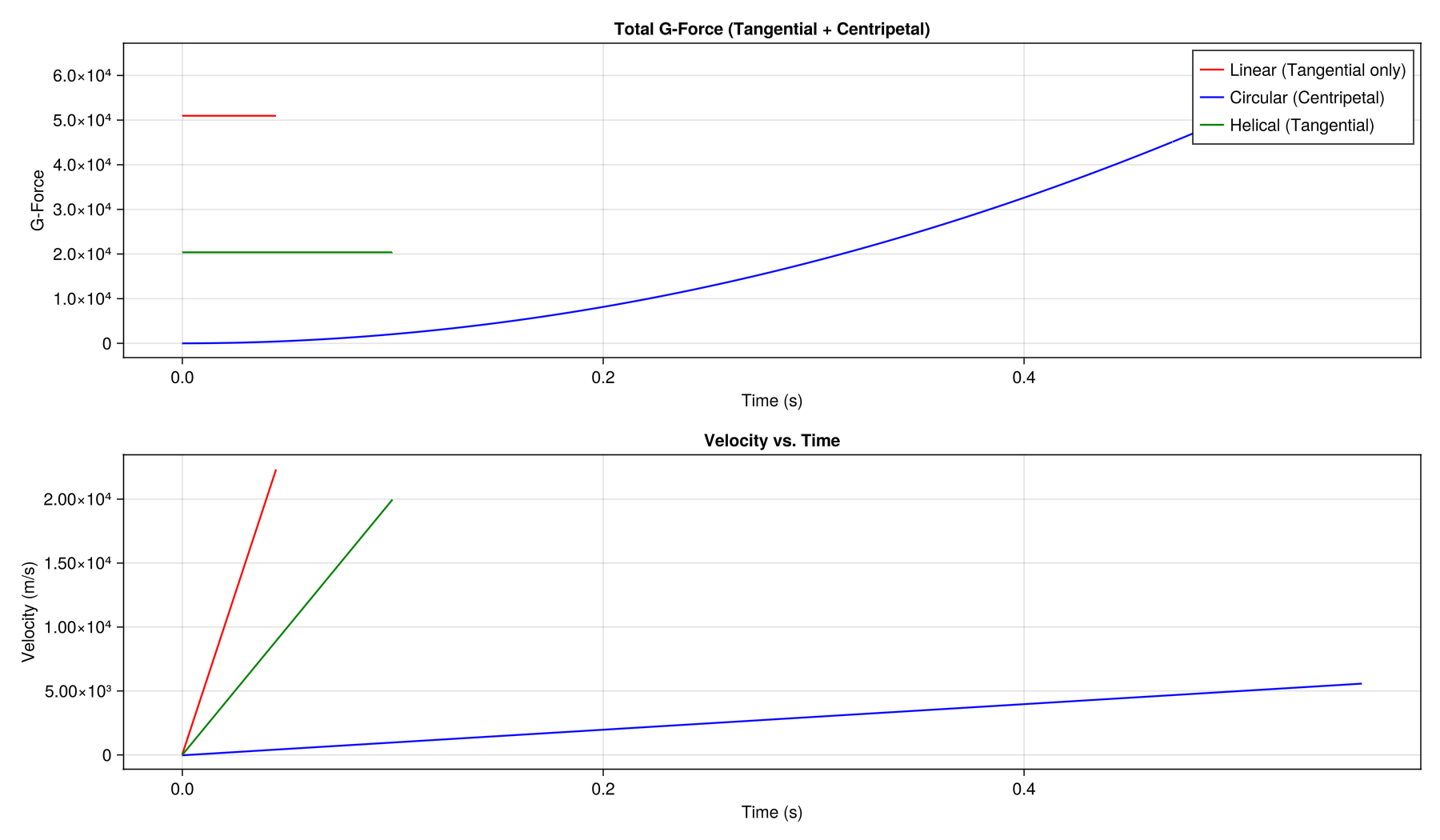
The following clips show a simplified linear-rail demonstration. Specific system details remain withheld while patent review is ongoing.
NDA Notice #
System specifics, geometry, and performance targets are under NDA and are not shown here.