
Overview #
Thermal modeling for CubeSat subsystems across launch and orbital thermal cycles. The focus is to predict temperature ranges, identify hot spots, and guide thermal design choices early in the build.
Role / Team / Timeline #
Role: Thermal modeling, material-property research, and test-data analysis
Team: UBC Orbit
Timeline: Ongoing
Technical Approach #
- Started in ANSYS Thermal Desktop, then moved the modeling workflow into Siemens Simcenter 3D.
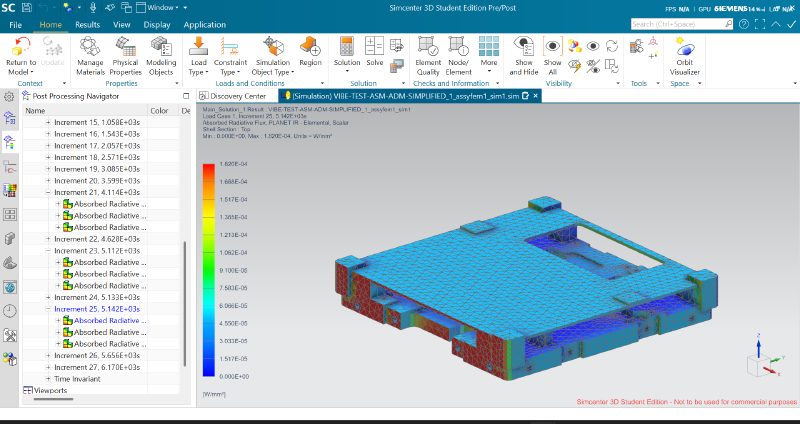
- Built thermal models with subsystem geometry, mesh setup, radiation environments, and orbital load cases.
- Researched and recorded material properties: absorptivity, emissivity, thermal conductivity, density, specific heat, and thermal contact conductance.
- Calculated contact values between materials so the model behaves closer to the real assembly instead of idealized perfect contact.
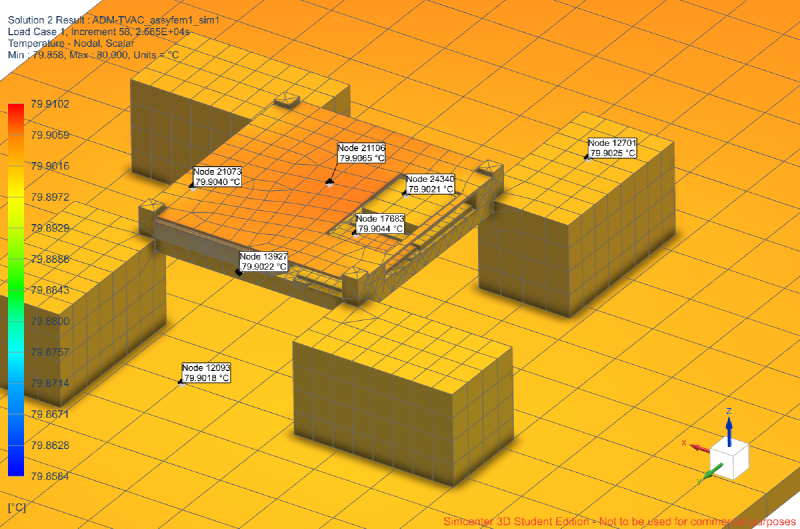
- Worked on post-processing thermal maps, radiative flux, and node-level temperature outputs.
- Current work includes thermal data analysis from UBC Orbit’s recent testing campaign at the European Space Agency center in Brussels, Belgium.
Results #
The current model supports design iteration by exposing hot spots, thermal margins, and sensitivity to material/contact assumptions. Final temperature ranges and validation results will be added once the testing-campaign analysis is complete.
Tools / Stack #
- ANSYS Thermal Desktop
- Siemens Simcenter 3D
- FEM thermal analysis
- Material property research
- Thermal test-data analysis
Links / Media #