

Overview #
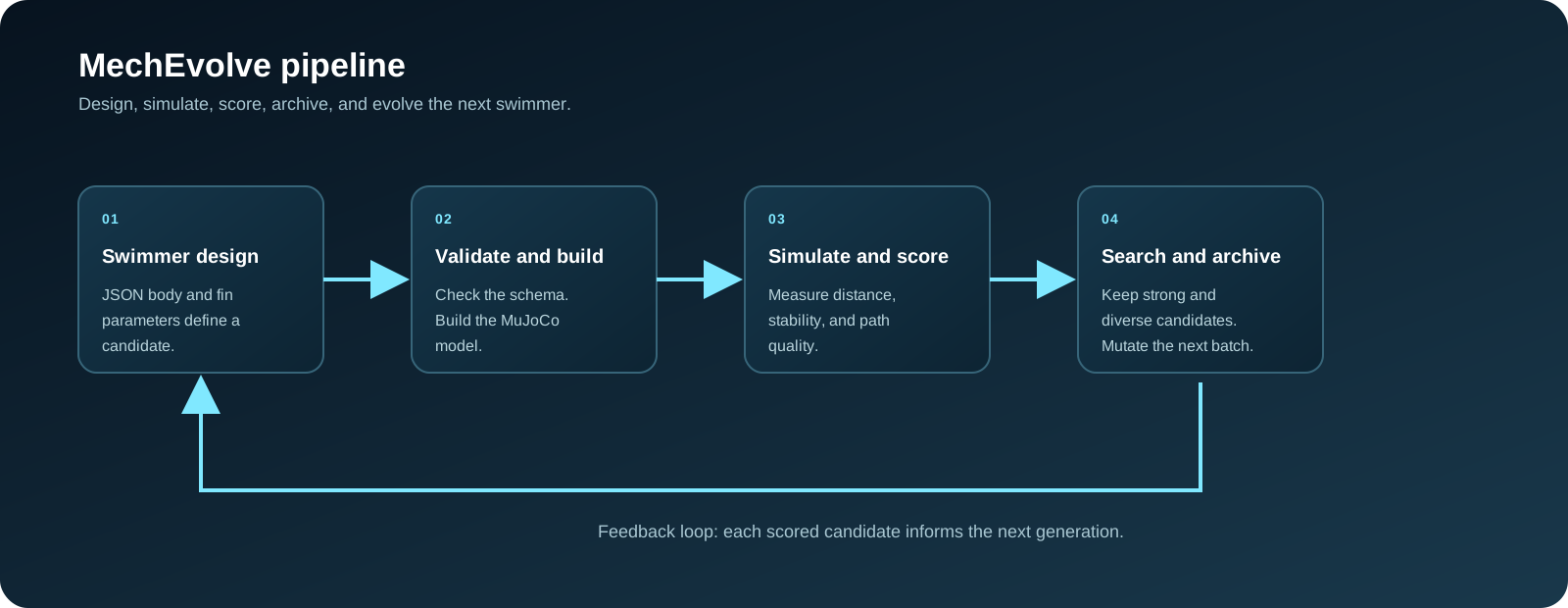
MechEvolve is an ongoing study of whether a model can help improve a simulated swimmer. A swimmer design is stored as JSON, converted into MuJoCo, and tested for motion and stability. The results guide the next design proposal.
The system uses evolutionary search and a MAP-Elites archive. A local model can suggest a bounded change. Deterministic simulation and validation decide if the change is useful.
This resembles weak recursive self-improvement, but it is not full RSI. The model does not change its own weights. It helps search a fixed design space.
Pipeline #
Fish Mk1: current progress #
Fish Mk1 is the strongest result from the restricted search. It has three body
segments, two hinge joints, and seven fins. The current candidate is
g009_0232_mut, found in generation 9.
- Simulation score: 0.6075
- Forward distance: 1.623 m
- Path efficiency: 0.9969
- Reversals, lane exits, and unstable steps: 0
These results come from the current MuJoCo protocol. They do not represent a finished physical design. The search uses only the Mk1 topology.
Evolution reel #
The reel shows the best tracked candidate from each stage. The first and final clips play at full speed. The middle clips play faster so the change is easy to scan. The reel does not show every candidate.
First versus final #
| Metric | Generation 0 | Generation 9 | Change |
|---|---|---|---|
| Candidate | g000_0017_mut |
g009_0232_mut |
Final candidate |
| Simulation score | 0.4811 | 0.6075 | +26.3% |
| Forward distance | 0.535 m | 1.623 m | 3.0x |
| Reversals | 0 | 0 | No change |
| Lane exits | 0 | 0 | No change |
| Unstable steps | 0 | 0 | No change |
The score and distance improved during the restricted run. The safety metrics were zero at both endpoints. These comparisons describe simulation results. They do not establish physical performance.
Next steps #
The next phase will improve result reliability before the search space expands:
- Test the anchor and finalist with multiple seeds and fluid conditions.
- Report progress, stability, smoothness, and energy as separate metrics.
- Add new body topologies after the current benchmark is stable.
- Link each design to its parent, mutation, metrics, and behavior niche.
The goal is a reproducible study of how body and control changes affect performance. The current simulated fish is not a deployable robot.
Status #
This project is ongoing. Fish Mk1 is the current restricted-search result. Further testing and broader body-design experiments are planned.
Tools #
- Python, MuJoCo, Gymnasium, and Stable-Baselines3 for the simulation loop.
- Evolutionary mutation, crossover, de-duplication, and MAP-Elites archiving.
- JSON design artifacts, evaluation metrics, trajectories, visual audits, and stitched elite reels for reproducibility.
- Ollama-compatible local models as bounded advisors to the search.